
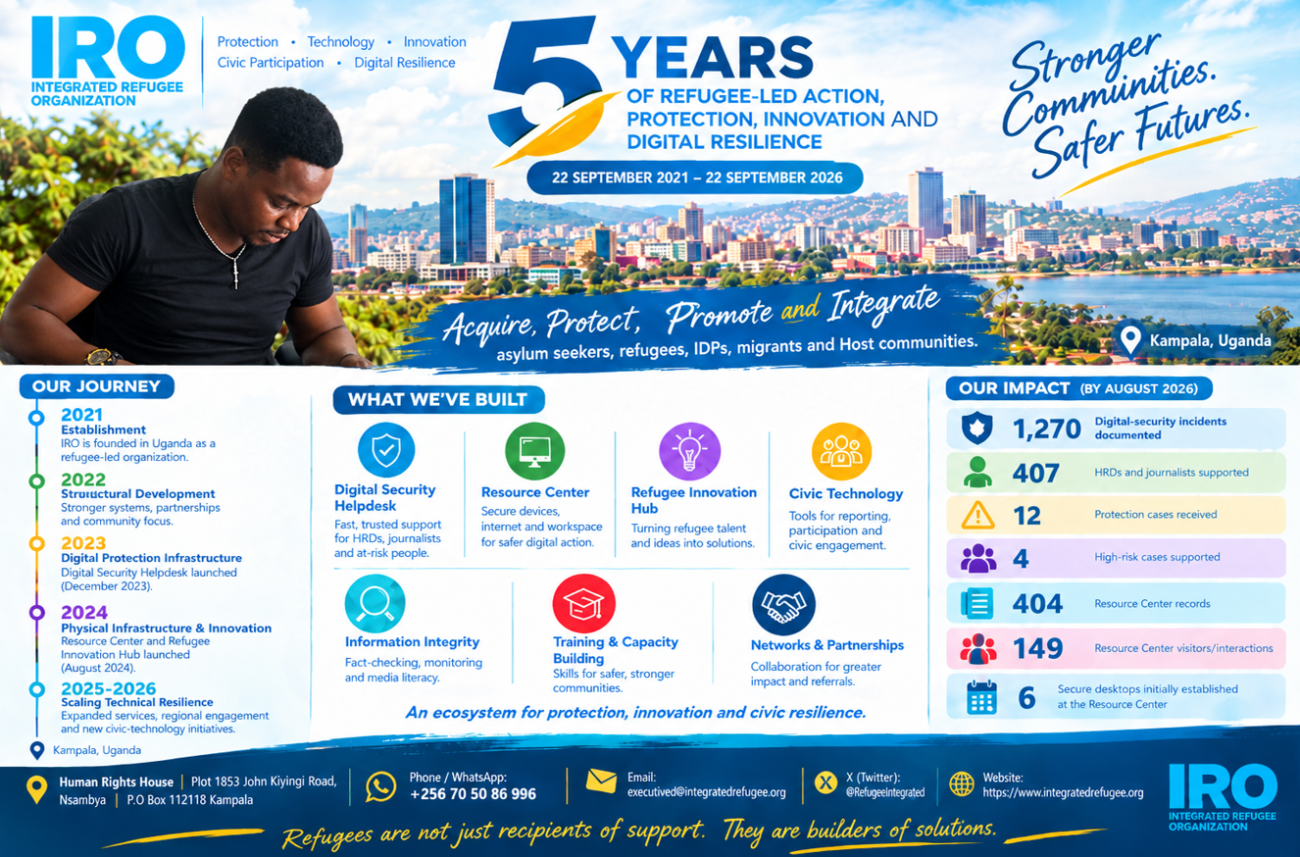
Five-Year Institutional Achievement Report
22 September 2021 – 22 September 2026
Integrated Refugee Organization (IRO)
Kampala, Uganda
- Executive Summary
On 22 September 2026, Integrated Refugee Organization (IRO) marks five years of continuous existence as a refugee-led organization established in Uganda to respond to the realities, vulnerabilities and aspirations of refugees, asylum seekers, displaced people, migrants and host communities.
Five years ago, IRO began with a simple but important conviction: refugees should not only be recipients of protection and humanitarian assistance; they can also be organizers, innovators, technologists, advocates, researchers, service providers and leaders of solutions affecting their communities.
Since its establishment in 2021, IRO has progressively developed from a young refugee-led initiative into an organization with practical infrastructure, technical expertise, community-facing services and an expanding network of partners.
Its work has increasingly focused on the intersection between protection, technology, civic participation, digital security, information integrity, refugee innovation and community resilience.
A major achievement has been the establishment of a practical digital-security and protection ecosystem. IRO launched its Digital Security Helpdesk in December 2023 and its Resource Center and Refugee Innovation Hub in August 2024, creating physical and digital spaces where human rights defenders (HRDs), journalists, activists and other at-risk people can obtain technical assistance, secure access to technology and practical support.
By August 2026, IRO’s digital-security work had supported 407 HRDs and journalists and recorded 1,270 incidents, alongside hundreds of Resource Center interactions and records. These figures represent not merely statistics, but people facing account compromise, phishing, malware, insecure devices, weak authentication, loss of access to digital platforms and other forms of digital risk.
Over five years, IRO has therefore built more than an organization. It has built infrastructure for resilience.
The organization’s journey has demonstrated that refugee-led organizations can develop specialized technical capacities, operate sophisticated digital-security services, build civic-technology solutions and contribute to wider conversations about technology and Africa’s future.
The fifth anniversary is consequently both a moment of celebration and a moment of reflection: five years of building, learning, responding, innovating and creating systems that did not previously exist.
- The Beginning: Building an Organization in Exile
IRO was formally established in Uganda in September 2021, in a context in which refugees and displaced communities continued to face significant barriers to meaningful participation, protection and access to opportunities.
The organization emerged from lived experience and practical knowledge of displacement.
Rather than designing an organization exclusively from an external institutional perspective, IRO’s approach has been shaped by the realities experienced by refugees and people living in exile: vulnerability to political and digital threats, limited access to resources, displacement-related uncertainty, barriers to technology, documentation challenges and the need for communities to develop their own resilience.
From its beginning, IRO adopted a broad mandate covering:
- refugees and asylum seekers;
- internally displaced and displaced populations;
- migrants;
- host communities;
- human rights defenders;
- journalists;
- activists;
- women and youth;
- communities facing heightened protection risks; and
- people and organizations requiring practical digital-security and civic-technology support.
The organization gradually developed an institutional identity around a central principle:
Refugee-led solutions should be designed with refugees, delivered with refugees and strengthened through refugee leadership.
This principle has informed IRO’s evolution over the past five years.
- From an Idea to an Operational Organization
One of IRO’s important achievements during its first five years has been the transformation from an emerging refugee-led organization into an organization with recognizable systems, programs and operational infrastructure.
IRO has progressively established:
- organizational governance and administrative structures;
- digital communication and service channels;
- a public-facing website;
- a Digital Security Helpdesk;
- a Digital Security Resource Center;
- the Refugee Innovation Hub;
- civic-technology concepts and platforms;
- anonymous reporting infrastructure;
- digital-security training capacity;
- partnerships and referral mechanisms;
- technical documentation and research capacity; and
- specialized expertise in digital protection and resilience.
This institutional development is particularly significant because IRO has not simply concentrated on delivering activities. It has sought to build systems capable of continuing to provide support to communities over time.
The organization has therefore moved progressively from project-based intervention toward an infrastructure-oriented approach.
- Establishing the IRO Digital Security Helpdesk
One of IRO’s most significant institutional achievements has been the creation and operation of the Digital Security Helpdesk, launched in December 2023 (https://integratedrefugee.org/helpdesk/).
The Helpdesk was created around a practical need:
Sustaining a digital security helpline and resource center to build local resilience among HRDs in exile.
The service responds to real digital-security problems faced by HRDs, journalists, activists and other people at risk.
Support has included assistance relating to:
- compromised accounts;
- phishing;
- malware;
- insecure devices;
- outdated software;
- missing or weak two-factor authentication;
- compromised WhatsApp accounts;
- Facebook account problems;
- Google account security;
- X/Twitter-related incidents;
- antivirus gaps;
- VPN and connectivity concerns;
- digital evidence and security practices; and
- broader digital-risk assessment and remediation.
IRO has developed multiple channels through which people can seek assistance, including web-based support, messaging platforms and direct communication.
This has transformed digital security from an abstract technical subject into a community-facing protection service.
- The Helpdesk as a Protection Infrastructure
The Helpdesk’s development represents an important conceptual achievement.
Rather than treating digital security as an isolated IT function, IRO has increasingly positioned it as part of human-rights protection and organizational resilience.
For an HRD or journalist whose account is compromised, for example, the problem is not simply a technical inconvenience. It can affect:
- confidential communications;
- sources;
- documentation;
- organizational operations;
- personal safety;
- public reputation;
- access to social-media platforms;
- evidence; and
- the ability to continue civic work.
IRO’s Helpdesk therefore sits at the intersection of technology and protection.
The organization has also developed referral and escalation relationships, including cooperation mechanisms that enable cases beyond IRO’s capacity to be referred to specialized partners.
This has helped establish an ecosystem in which a refugee-led organization can serve as an initial technical-response point while connecting people to more specialized assistance when required.
- The Resource Center: Turning Digital Security into Physical Infrastructure
Another major milestone was the launch of the Digital Security Resource Center and Refugee Innovation Hub on 29 August 2024 (https://integratedrefugee.org/resource-centre-digital-security-helpline-support-and-refugee-innovation-hub-launch/).
The Resource Center created a physical environment where refugees, HRDs, journalists and other users could access:
- secure computers;
- secure internet access;
- workspace;
- digital-security assistance;
- technical guidance;
- learning opportunities; and
- practical technology resources.
The Center initially included six secure desktops, establishing an important principle: digital security cannot be addressed only through online advice when many people do not have access to secure devices or safe working environments.
The Resource Center consequently became a practical extension of the Helpdesk.
It provided a place where people could not only ask:
“How do I secure my account?”
but also access an environment in which they could actually undertake safer digital practices.
- Refugee Innovation and Technology
The establishment of the Refugee Innovation Hub represented another evolution in IRO’s approach.
IRO has increasingly viewed refugees not only as communities requiring assistance but also as communities containing:
- technical skills;
- entrepreneurial ideas;
- creative capacity;
- community knowledge;
- digital innovation;
- youth leadership; and
- solutions that can contribute to wider society.
The Refugee Innovation Hub therefore complements protection activities with a broader vision of refugee agency.
This has helped position IRO within an emerging conversation about how refugees can contribute to technology, entrepreneurship, civic innovation and Africa’s digital future.
- Developing Civic Technology
IRO’s work has increasingly expanded beyond conventional digital-security assistance into civic technology.
The organization has explored and developed tools and concepts designed to help communities:
- report human-rights violations;
- communicate securely;
- document incidents;
- access protection;
- participate in civic processes;
- receive digital-security assistance;
- strengthen organizational resilience; and
- use technology to increase meaningful civic participation.
One example is IRO Safereport (https://integratedrefugee.org/anonymous-human-rights-violations-reporting-system-in-africa/), an anonymous human-rights-violation and technology-facilitated gender-based violence reporting concept.
IRO has also explored technology for HRD management, case management and secure community engagement.
These initiatives demonstrate an important evolution in IRO’s thinking: technology should not simply connect people; it should help people participate safely.
- Information Integrity, Civic Intelligence and Digital Resilience
IRO has also been developing a broader area of work around Information Integrity, Civic Intelligence and Digital Resilience.
This represents an expansion from responding to individual digital-security incidents toward understanding the wider information environment in which communities operate.
The emerging area includes:
- fact-checking and verification briefs;
- collaborative investigations;
- monitoring and early warning;
- research and policy outputs;
- media and information literacy;
- training;
- information verification; and
- digital resilience.
This direction recognizes that threats to civic participation are not limited to hacked accounts or compromised devices.
Communities can also be affected by:
- false information;
- manipulated information;
- impersonation;
- coordinated online abuse;
- unreliable digital evidence;
- information gaps; and
- rapidly changing digital environments.
IRO’s response has therefore increasingly combined digital security with information resilience.
- Building Technical Capacity
IRO’s institutional development has been strengthened by significant technical expertise within its leadership and team.
The organization’s work draws on long-term practical experience in:
- information and communications technology;
- digital security;
- incident response;
- digital-security training;
- security assessments;
- digital-risk analysis;
- human-rights documentation;
- technology support; and
- refugee-led organizational development.
This technical foundation has enabled IRO to move beyond general awareness-raising toward more specialized services.
The organization’s broader technical experience includes work involving digital-security training, security assessments, incident handling and support to human-rights defenders across multiple countries.
The accumulated experience has helped IRO understand digital threats from both sides: the technical side of the threat and the human-rights consequences of the threat.
- A Growing Record of Digital Security Response
The scale of IRO’s Helpdesk work provides one of the clearest measures of institutional achievement.
By August 2026, IRO had documented:
- 1,270 digital-security incidents
- 407 HRDs and journalists supported
- 12 protection cases received
- 4 high-risk cases supported
In addition, the Resource Center had accumulated:
- 404 Resource Center records
- 149 Resource Center visitors/interactions
These numbers demonstrate that IRO’s digital-security infrastructure is being used in practice.
They also show an important transition: IRO is no longer simply proposing that refugees and civil-society actors need digital protection.
IRO has built a mechanism through which that protection can actually be delivered.
- Responding to the Real Digital Threat Landscape
The incidents handled by IRO have provided valuable practical insight into the changing threat environment facing civil society.
The organization’s experience has included cases involving:
- compromised accounts;
- phishing attempts;
- malware;
- insufficient device protection;
- missing 2FA;
- insecure communications;
- compromised social-media accounts;
- outdated software;
- inadequate backup practices;
- insecure use of devices and platforms; and
- challenges related to maintaining secure communications.
This practical exposure has allowed IRO to identify recurring weaknesses and use those lessons to inform training, technical assistance and organizational security assessments.
The Helpdesk has therefore become not only a service mechanism but also a source of institutional learning.
- Supporting Organizations, Not Only Individuals
Another important achievement has been IRO’s increasing capacity to work with organizations rather than limiting its intervention to individual users.
Digital security becomes sustainable when organizations establish:
- secure policies;
- appropriate access controls;
- device inventories;
- secure backups;
- authentication standards;
- incident-response procedures;
- evidence-management practices;
- staff awareness;
- secure communication protocols; and
- organizational continuity mechanisms.
IRO has consequently developed experience supporting organizations to understand their own digital-risk environment.
This has included digital-security assessments and technical consultations that examine both technology and organizational practices.
- Digital Security Audits and Organizational Resilience
IRO’s technical work has also expanded into security-audit and assessment methodologies.
Through its broader technical expertise, the organization has worked with civil-society actors to identify:
- equipment gaps;
- insecure practices;
- inadequate storage;
- insufficient digital skills;
- weaknesses in documentation;
- absence of asset inventories;
- inadequate backup arrangements;
- insufficient protection of organizational data; and
- training requirements.
This approach recognizes that security is not created by purchasing a single software product.
It is created through a combination of:
people + processes + technology + awareness + organizational culture.
- The Refugee-Led Comparative Advantage
One of IRO’s defining institutional achievements is its ability to combine refugee leadership with technical expertise.
This combination matters.
IRO understands displacement not only as an external policy issue but as a lived reality.
At the same time, the organization has developed technical capacity in areas that are increasingly important to people living and working in exile.
This creates a distinctive position at the intersection of:
Refugee protection
- Digital security
- Human rights
- Technology
- Civic participation
- Innovation.
IRO’s experience demonstrates that refugee-led organizations can develop specialized technical institutions rather than remaining confined to conventional humanitarian roles.
- From Uganda to Regional Engagement
Although rooted in Uganda, IRO’s work has increasingly developed a regional dimension.
The organization’s technical experience has included engagement with defenders and civil-society actors across multiple countries, particularly through digital-security training, assessments, incident response and technical support.
This experience provides a foundation for IRO’s current efforts to strengthen digital resilience among communities in Uganda and across the Great Lakes region.
The organization has increasingly recognized that digital threats do not stop at national borders.
For people in exile, communications, networks, organizations and threats frequently operate across borders.
IRO’s refugee-led perspective is therefore particularly relevant to regional digital protection.
- Creating an Ecosystem Rather Than a Single Project
A defining characteristic of IRO’s five-year journey is the gradual movement from isolated activities toward an interconnected ecosystem.
The organization’s current model can be understood as:
HELPDESK → immediate digital-security assistance
RESOURCE CENTER → secure physical access to technology and support
INNOVATION HUB → refugee innovation and technology
CIVIC TECHNOLOGY → secure participation and reporting
INFORMATION INTEGRITY → verification, monitoring and resilience
TRAINING → skills and local capacity
NETWORKS & PARTNERSHIPS → referrals, escalation and collective resilience
Together, these components create an institutional architecture rather than a collection of disconnected projects.
- Refugee Market and Community Economic Participation
IRO’s work has also extended beyond protection and digital security into community-based economic participation.
The development of the Refugee Market provides an avenue for refugee vendors and entrepreneurs to participate in an organized community marketplace.
The model includes a modest vendor contribution mechanism and is part of the broader objective of creating opportunities for refugees to participate economically and build greater independence.
This complements IRO’s innovation agenda by recognizing that refugee resilience includes not only physical and digital protection but also economic agency.
- Partnerships and Collaboration
IRO’s growth has been supported by engagement with a wider ecosystem of organizations working in human rights, digital security, civic technology and refugee protection.
The organization’s experience has involved relationships and cooperation around:
- digital-security referrals;
- incident escalation;
- technical support;
- training;
- civic technology;
- refugee innovation;
- research;
- organizational security;
- information integrity; and
- protection.
IRO has also developed mechanisms for working alongside specialized organizations when an incident exceeds its own capacity.
This reflects an important institutional lesson from the first five years:
No single organization can provide every form of protection. Strong referral and collaboration systems are therefore part of effective protection infrastructure.
- Innovation as an Institutional Culture
Innovation has increasingly become part of IRO’s organizational identity.
Rather than asking only:
“What service can we deliver?”
IRO has increasingly asked:
“What infrastructure is missing, and can a refugee-led organization build it?”
That question has led to the development of:
- the Digital Security Helpdesk;
- the Resource Center;
- the Refugee Innovation Hub;
- Safereport;
- civic-technology concepts;
- digital verification initiatives;
- information-integrity work;
- technical protection models; and
- digital-resilience infrastructure.
This represents one of IRO’s most important achievements over five years.
- Contribution to the African Technology Conversation
IRO’s work has also increasingly entered broader conversations about technology and Africa.
The organization’s work on AI Made in Africa (https://integratedrefugee.org/ai-made-in-africa-why-refugee-led-smes-must-be-part-of-africas-ai-future/) and the role of refugee-led SMEs in Africa’s AI future reflects a broader institutional vision (https://www.youtube.com/watch?v=cRgrZGBvEzs).
IRO is seeking to ensure that refugees and displaced communities are not excluded from conversations about:
- artificial intelligence;
- digital transformation;
- entrepreneurship;
- innovation;
- technology policy; and
- Africa’s technological future.
This is consistent with the organization’s wider philosophy: refugees should not only consume technology; they should participate in shaping the technologies and policies that affect their future.
- Five Years of Learning
IRO’s first five years have also produced important institutional lessons.
Lesson 1: Refugee-led organizations can build specialized technical institutions.
The experience of the Helpdesk and Resource Center demonstrates that refugee-led organizations can provide specialized technical services when they are trusted and adequately supported.
Lesson 2: Digital security is a protection issue.
Digital incidents can have direct consequences for safety, confidentiality, civic participation and organizational continuity.
Lesson 3: Infrastructure matters.
Training is important, but people also need access to secure devices, safe internet, technical assistance and physical spaces.
Lesson 4: Local expertise is essential.
People who understand the local and regional context can often identify practical risks and solutions that externally designed systems may overlook.
Lesson 5: Refugee innovation is an asset.
Refugee communities are not simply populations to be assisted. They possess knowledge, creativity, technology skills, entrepreneurship and leadership.
Lesson 6: Resilience must be continuous.
Digital threats change continuously. Protection therefore cannot be a one-time training event. It requires continuing assistance, monitoring, learning and adaptation.
- The Human Meaning Behind the Numbers
The numbers recorded by IRO’s Helpdesk are important, but they represent much more than statistics.
Behind every incident is a person.
Behind an account-recovery request may be a journalist trying to protect sources.
Behind a malware incident may be an activist trying to continue documenting abuses.
Behind a request for secure internet access may be an HRD who cannot safely work from their normal environment.
Behind a digital-security training may be an organization trying to protect an entire team.
Behind the Resource Center statistics are people who needed a place where they could work more safely.
The real achievement of IRO is therefore not simply that it recorded 1,270 incidents.
It is that, over time, a refugee-led organization built a mechanism through which people could say:
“I have a problem, and there is somewhere I can go for help.”
- Five Years of Institutional Growth
IRO’s journey can broadly be understood through five stages.
2021 — Establishment
IRO is founded in Uganda as a refugee-led organization with a commitment to refugee protection, community resilience and empowerment.
2022 — Institutional Development
The organization strengthens its identity, systems, partnerships and community-oriented approach.
2023 — Digital Protection Infrastructure
The Digital Security Helpdesk is launched, establishing a dedicated mechanism for digital-security assistance.
2024 — Physical Infrastructure and Innovation
The Resource Center and Refugee Innovation Hub are launched, bringing secure technology access and refugee innovation into a physical community space.
2025–2026 — Scaling Technical Resilience
IRO expands its digital-security response, information-integrity work, civic-technology concepts, regional engagement and technical protection models.
The organization enters its sixth year with a substantially stronger institutional foundation than it had at its establishment.
- Five Years in Numbers
Where documented, IRO’s five-year journey includes:
Area | Achievement |
Years of existence | 5 years |
Digital-security incidents documented/supported by Aug. 2026 | 1,270 |
HRDs and journalists supported/helped | 407 |
Protection cases received | 12 |
High-risk cases supported | 4 |
Resource Center records | 404 |
Resource Center visitors/interactions | 149 |
Digital Security Helpdesk launched | 19-Dec-23 |
Resource Center / Refugee Innovation Hub launched | 29-Aug-24 |
Secure desktops initially established | 6 |
These figures should be understood as indicators of an evolving service infrastructure rather than a complete measure of IRO’s overall impact.
- The Next Chapter: From Five Years to Sustainable Infrastructure
The fifth anniversary also marks the beginning of a new phase.
IRO’s next challenge is not simply to do more of the same.
It is to institutionalize, strengthen and scale what has already been built.
The organization is looking toward:
- expanding digital-security services to refugee settlements;
- strengthening the Helpdesk;
- expanding secure Resource Centers;
- reaching Nakivale and Kyaka II;
- strengthening services for HRDs and journalists;
- increasing support for women, youth and other communities facing heightened digital risks;
- expanding technical training;
- strengthening incident-response mechanisms;
- improving evidence-security infrastructure;
- developing civic-technology tools;
- strengthening information-integrity work;
- expanding regional digital-resilience programming; and
- developing sustainable partnerships and financing.
The long-term vision is to establish an interconnected network of digital safe spaces and protection infrastructure accessible to people who would otherwise have limited access to specialized technical support.
- A Five-Year Legacy
Five years ago, IRO began as a refugee-led organization with a vision.
Five years later, that vision has developed into tangible infrastructure.
There is now:
- a Helpdesk;
- a Resource Center;
- a Refugee Innovation Hub;
- digital-security expertise;
- incident-response experience;
- civic-technology development;
- information-integrity work;
- community reporting mechanisms;
- technical training capacity;
- organizational security assessment experience;
- regional networks; and
- a growing body of institutional knowledge.
Perhaps the most important achievement is the demonstration that being refugee-led does not mean being limited in ambition, technical capacity or institutional vision.
IRO’s five-year journey challenges the assumption that refugees should only be viewed through the lens of vulnerability.
It demonstrates another possibility:
- Refugees can build institutions.
- Refugees can build technology.
- Refugees can provide protection.
- Refugees can lead innovation.
- Refugees can contribute to civic resilience.
- Refugees can help shape Africa’s digital future.
28. Five Years of Existence — and a Future of Greater Purpose
As IRO marks five years of existence on 22 September 2026, the organization can look back on a journey defined by persistence, experimentation, technical learning and community service.
The organization has operated in an environment where resources are limited, digital threats are evolving, civic space is challenging and the needs of displaced communities are continually changing.
Yet, day by day, IRO has continued to build.
The five-year anniversary is therefore not only a celebration of the organization’s survival.
It is a celebration of institution-building.
It is a celebration of the people who sought assistance, the staff and volunteers who responded, the partners who supported the work, the communities that trusted IRO, and the refugee leaders who demonstrated that displacement does not eliminate the capacity to create solutions.
From a small refugee-led organization established in Uganda in 2021, IRO has developed an increasingly distinctive model centered on:
Protection. Technology. Innovation. Civic participation. Digital resilience. Refugee leadership.
The next five years will be about turning that foundation into stronger, more sustainable and more accessible infrastructure.
The ambition is not simply to grow IRO.
It is to demonstrate what becomes possible when refugee communities are trusted not only as beneficiaries, but as leaders, technologists, innovators and builders of their own future.
Acknowledgement
IRO’s achievements over the past five years belong to the wider community that has made the organization’s work possible.
IRO recognizes the refugees, asylum seekers, human rights defenders, journalists, activists, community leaders, innovators, partners, supporters, technical experts, staff and volunteers who have contributed to this journey.
Every incident responded to, every person assisted, every training delivered, every secure workspace made available, every innovation developed and every partnership established has contributed to the institution that IRO is today.
Five years completed.
The work continues.
Integrated Refugee Organization (IRO)
22 September 2026
