
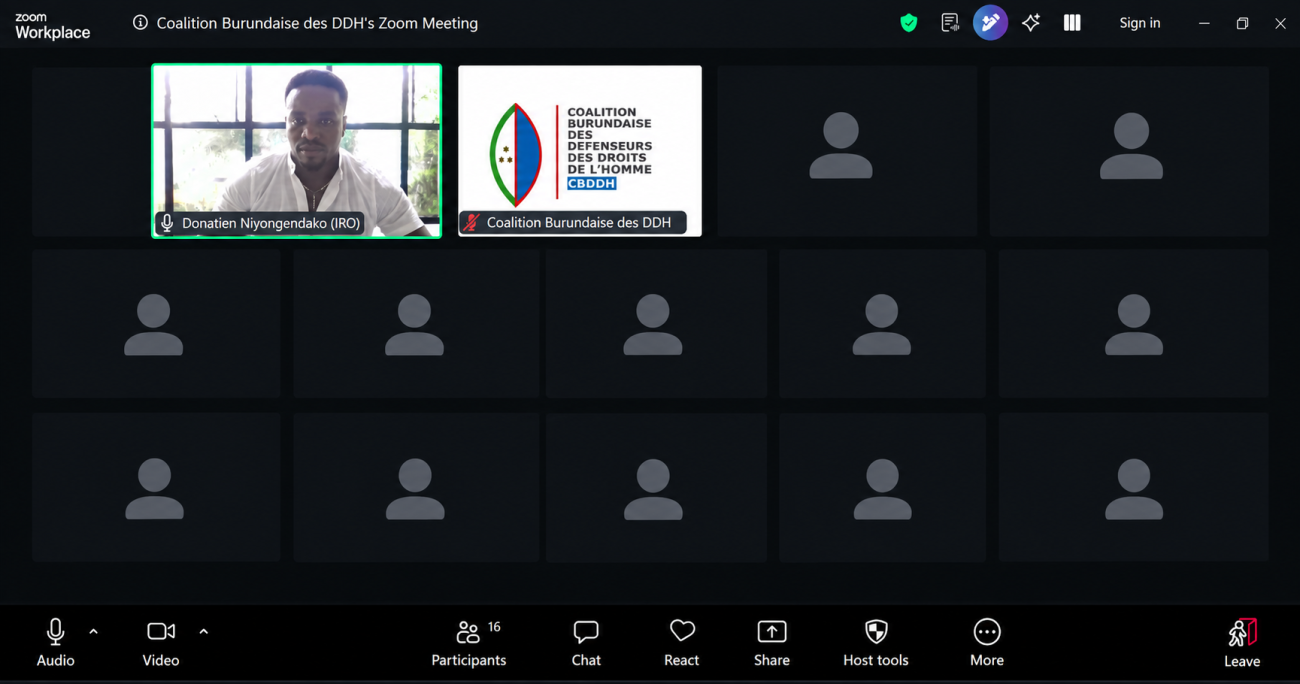
The coalition Burundaise des Défenseurs des Droits Humains (CBDDH) in collaboration with the Integrated Refugee Organization (IRO) conducted a practical training in August 2026 for young people and women human rights defenders (HRDs) from Burundi living in exile, with the aim of strengthening their ability to use digital technologies in a secure, responsible and strategic manner for documentation, communication and advocacy.
The training adopted a highly practical approach combining technical presentations, demonstrations, hands-on exercises using participants’ own devices and accounts, simulations and practical assignments. Rather than focusing solely on awareness, the training enabled participants to identify the risks they face and directly implement appropriate protection measures.
An Ecosystem-Based Approach to Digital Security
The training introduced an approach in which digital security goes beyond protecting a password. Participants examined the main components of their digital ecosystem: people and contacts, data, devices, accounts and communications.
Particular attention was given to the risks faced by human rights defenders, including account compromise, phishing, device loss or theft, exposure of sensitive information, location-related risks and threats targeting digital communications.
Participants also explored the distinction between data at rest—stored on phones, computers, USB drives, cloud services or backups—and data in transit, including communications, downloads, publications and file transfers.
Securing Devices and Online Accounts
The training covered key layers of device protection, including PINs or passwords, encryption, software updates, backups and automatic screen locking. Participants were introduced to encryption verification on Windows and macOS and to the importance of securely protecting recovery keys.
Mobile phones were treated as a critical component of digital identity. Practical exercises covered location controls, Wi-Fi and Bluetooth management, sensitive notification settings, operating system and application updates, and backup configuration.
Account security was also addressed through two-factor authentication (2FA). Participants reviewed different authentication methods and applied an account-auditing approach to their Facebook, Instagram and X accounts, including active sessions, account recovery and security settings.
From Digital Security to Online Advocacy
The online advocacy component enabled participants to explore the opportunities offered by Facebook, Instagram and X, as well as the role of WhatsApp in mobilisation and community building.
Participants learned how to identify relevant information and target audiences, adapt the same message to different digital platforms, and plan coherent online communications. The training also introduced the use of X Spaces as a tool for dialogue, outreach and mobilisation around human rights issues.
Digital Content Production with Canva
A practical module focused on Canva, covering account creation, the platform interface and the use of its multimedia production tools.
Participants practiced creating flyers, posters, visual materials, videos and audio content, with the objective of developing greater autonomy in producing communication materials adapted to different digital platforms.
Towards Safer and More Strategic Advocacy Campaigns
The training ultimately connected digital security, strategic communication and advocacy. Practical exercises focused on developing advocacy messages, producing digital content, mobilising online communities and simulating a small-scale online advocacy campaign.
Through this approach, IRO aims to contribute to strengthening the digital resilience of human rights defenders in exile, particularly young people and women, enabling them to continue documenting violations, communicating with their audiences and conducting advocacy while reducing their exposure to digital risks.
Key message from the training: protect an ecosystem, not just a password.
